
EPA begins tong-term cleanup at former base
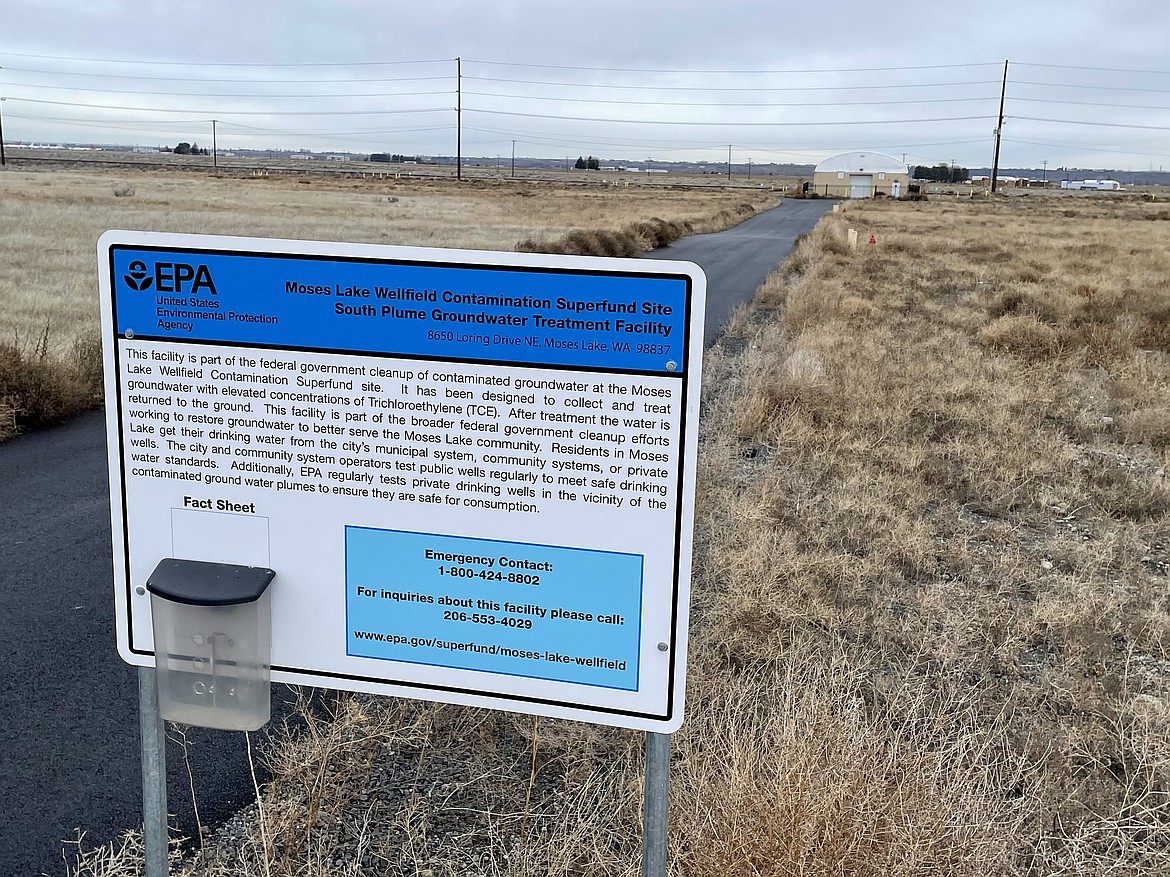
The Environmental Protection Agency's automated pumping and filtering building along Loring Road used to filter and treat groundwater contaminated with trichloroethylene (TCE), a solvent commonly used to clean and degrease aircraft in 1950s and 1960s. The EPA built the facility in 2020 as part of a long-term effort to clean up years of pollution left behind by the U.S. Air Force when Larson Air Force Base was closed in 1966, and expects to do the remediation work for the next several decades.
Charles H. Featherstone
MOSES LAKE — Five pounds.
That’s how much trichloroethylene (TCE) the U.S. Environmental Protection Agency has likely removed during the last year from a contaminated plume of groundwater underneath what used to be Larson Air Force Base, according to EPA Remedial Project Manager Brad Martin.
“The main concern is TCE in the ground water,” Martin said, noting that EPA has documented five plumes of contaminated groundwater in and around the port.
And that five pounds is enough to contaminate nearly 120 million gallons — 368 acre-feet — of water. According to the EPA, TCE is toxic and exposure has been linked to cancer, Parkinson’s disease, and other nervous system problems.
The TCE in the south plume is believed to emanate from the base’s south dump, Martin said, one of several major contamination sites at the former base that includes various dumps, burn pits, an aircraft wash rack and a liquid oxygen facility used in part to fuel a squadron of Atlas missiles stationed around the region in the early 1960s.
Martin said the TCE is pulled up by an automated pumping station along Loring Road, south of the Grant Transit Authority’s bus barn, the EPA spent the better part of 2020 building. Water is pumped from deep underground by five wells, put through a filter, and then pumped back into the ground once the TCE is pulled out.
All of this to reduce the levels of TCE — an industrial solvent which the U.S. Air Force used to clean airplanes and aircraft parts back in the 1950s and 1960s — to 5 parts-per-billion (ppb), the standard EPA maintains for drinking water.
Sampling wells at the site of the former dump off Loring Drive detected TCE levels well over that, with one well reporting TCE at 78 ppb, according to the EPA’s 2014 annual report on the site.
The facility is largely automated, Martin said, though workers monitor it remotely, come once a month to make sure everything is working properly, and can respond quickly in the event they need to.
“That’s a cost saving feature,” he said.
Martin said the filter on the remediation system, which the EPA is still tweaking and testing to find the optimal treatment rate, is probably close to being full, and he expects the EPA will need to change it in March.
“Once the TCE in the filter reaches a certain saturation point, the carbon is removed, the TCE is extracted and the carbon is recycled,” he said.
EPA expects to do the first filter replacement sometime in March, Martin said, with subsequent replacement coming every 9-12 months or so.
For the next 20-30 years.
“This will be running for decades,” he said.
Part of the reason the work is slow is the geology underneath Moses Lake. Martin said the nature of TCE combined with the fractured basalt aquifer deep underground makes it difficult to work quickly. TCE is heavier than water, so it sinks, and pulling water out too fast would trap the TCE in the ground.
“It’s very challenging to work with,” Martin said. “We’ve treated 36 million gallons of water, and the wells pull out 80 gallons per minute.”
That may sound like a lot, Martin explained, but it’s tiny when compared with what a city’s water system will pull from an aquifer.
The COVID-19 pandemic also slowed work, though it did not affect the speed of water treatment, Martin said.
Martin said the EPA and the Port of Moses Lake will continue to work together to address the problems left behind by the U.S. Air Force, including drilling test wells and evaluating soil samples from other potentially contaminated sites.
The EPA will also continue to help Cascade Valley residents who live atop one of the former base’s larger contaminated ground water plumes by installing filters on their water wells and regularly testing their water, if property owners allow it, Martin said.
Martin said the EPA is providing support to businesses and property owners looking to develop land sitting atop sites where it is possible to reuse and redevelop that land.
“Yes, we live and work on a Superfund site,” he said. “But there are opportunities.”
Charles H. Featherstone can be reached at [email protected].