


Ephrata's long-lost strike in bowling
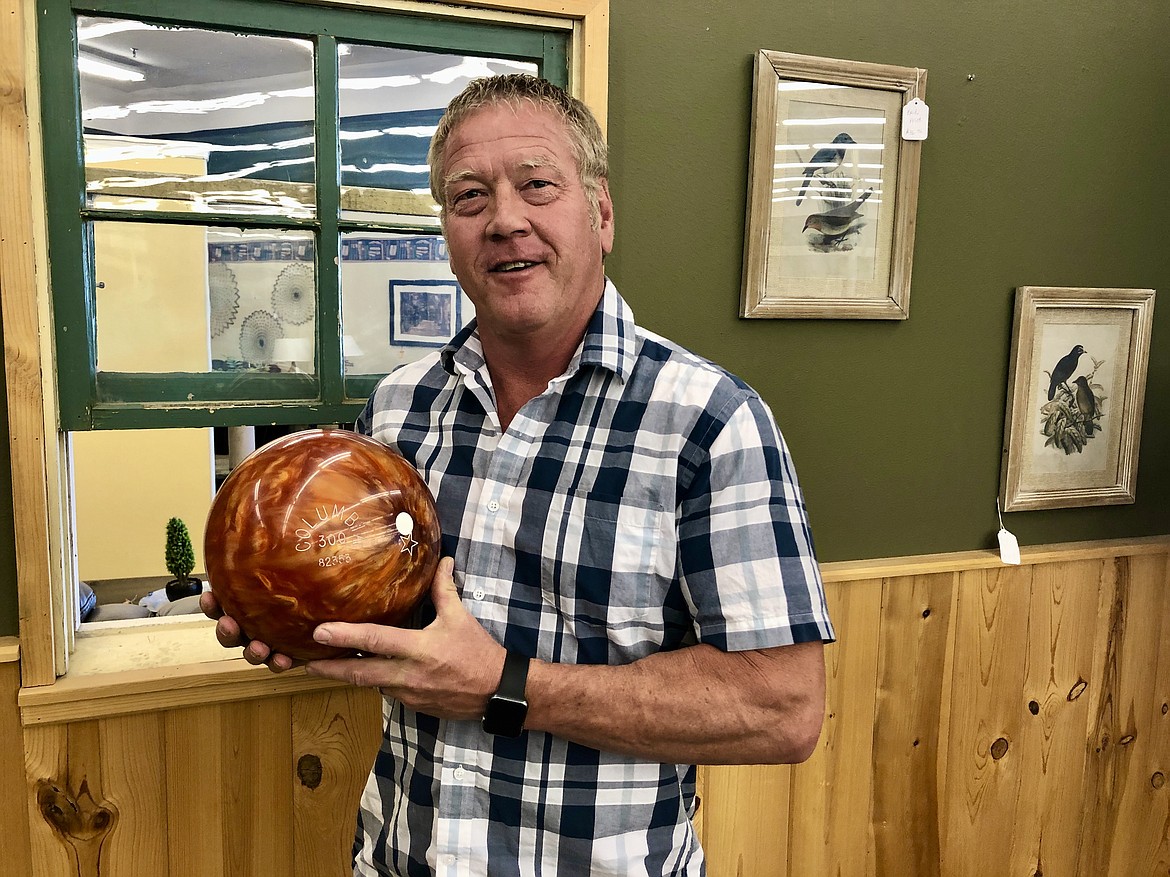
Kelly Moore, son of Lowell Moore, one of the original investors in Columbia Industries, holding that company's biggest invention, the colored bowling.
Charles H. Featherstone
EPHRATA — All that remains of the place where Ephrata revolutionized bowling is a patch of weedy debris that has been sitting under the Columbia Basin sun for nearly 60 years.
“It’s hard to believe this used to be a city of 7,500 people,” said Kelly Moore, 56, one of the co-owners of Moore Furniture, of the former Ephrata Army Air Base.
The base was built in 1939, and was eventually used to train B-17 pilots. It was closed not long after the Japanese surrender was signed in September 1945.
Moore is walking across one of the few remaining concrete foundations of the old Ephrata Army Air Base — now the Port of Ephrata — that he believes was likely once the base hospital.
And the factory where Columbia Industries, which manufactured the first bowling balls made out of colored plastic, were made in the very early 1960s.
“It’s hard to piece it all together,” Moore said. “By the time I got interested in the story, the only (original investor) left was my dad, Lowell Moore, and even his memory was starting to fail.”
Moore has pieced together some of the story, mostly from documents left by his father. Sometime in 1958 or 1959, Moses Lake inventor and plastic specialist Nick Mushkin had tinkered with old washing machine parts and figured out how to make bowling balls. He persuaded a group of investors, including Moore’s father Lowell and Ephrata Bowling Center owner Howard Nessen to invest $5,000 each to start making the new kind of bowling balls in Ephrata.
“Dad was a brilliant businessperson. Even in his mid-20s, he was starting to do some investing in things that didn’t involve selling furniture every day,” Moore said.
And so Columbia Industries was born and by 1961 was using its brand-new technology to make a brand-new kind of bowling ball.
Before 1961, all bowling balls were made of a very hard rubber known as Ebonite, Moore said, in two halves that were glued together. The ridge created by gluing the two halves was then sanded off, he said, but the process was prone to error.
Mushkin figured out how to cast a bowling ball in one piece out of plastic on a spindle.
“A lathe system would turn these balls and make them perfectly round,” he said.
Columbia Industries, with its still-recognizable multicolored Columbia 300 bowling ball, grew quickly, from total sales of $105,210 in 1960-61 to $1.6 million in 1963-64, according to the company’s 1964 annual report. Three more factories and a corporate headquarters were built, all in San Antonio, Texas, and Nessen was named the company’s vice president.
“Things happened really fast,” Moore said.
But tragedy struck too. The Ephrata factory burned down, likely in 1962, though Moore isn’t entirely sure when. And Brunswick Bowling — the industry leader in bowling equipment — decided to make its own plastic colored bowling balls, prompting Columbia Industries to sue for patent infringement.
“Brunswick was like, ‘Who are these guys? We’re not selling any balls, so let’s just do the same thing,’” Moore said. “Columbia sued, and won, but they spent too much money to win. They had to spend pretty much everything they made protecting their patent.”
“Brunswick was bowling,” Moore added.
Columbia Industries President Roger Seller, in a 1965 letter to Lowell Moore, offered him and the other Ephrata investors $6 per share for their portion of the company — more than the $4 per share he said the firm was really worth.
“They tripled their investment by the time they sold out,” Moore said.
Columbia Industries, now based in Muskegon, Michigan, changed hands a few times over the years, is now called Columbia 300 and is a wholly owned subsidiary of Brunswick Bowling Products — the same company the founders challenged with their brand-new plastic ball 60 years ago.
Brunswick still is bowling.
Moore said he has tried tracking Mushkin, the inventor, down to find out what happened to him. But he’s had no luck.
As glass and construction debris crunches under his feet, Moore said that during one of his walks a few years ago at the old factory site he found a somewhat strange looking rock that, when he picked it up, was much lighter than ordinary rocks.
“I thought ‘that feels like plastic,’” he said. “Sure enough. These were bowling balls that melted in the fire and baked in the sun.”