
Columbia Basin Investigative Team brings civilians into reviews of police shootings
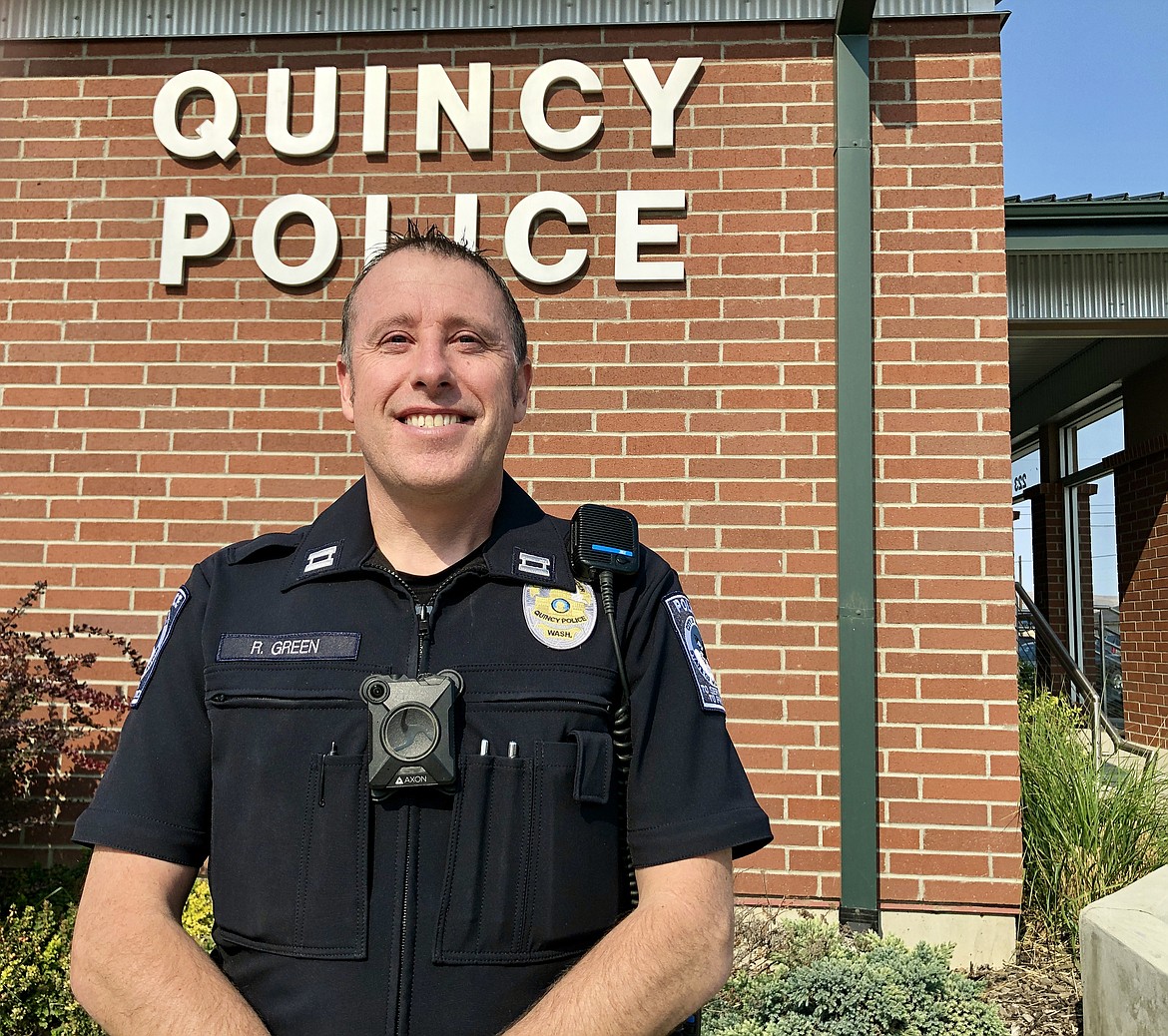
Quincy Police Capt. Ryan Green, who is also head of the Columbia Basin Investigative Team, which investigates officer-involved shootings in Grant, Adams and -- soon -- Kittitas counties.
Charles H. Featherstone
MOSES LAKE — In late February, Moses Lake Police Officer Nick Stewart shot and killed 22-year-old Jose Rivera after a long police chase.
In the process of being chased, Rivera had pulled out his own gun, opened fire, and among other things, hit K-9 Chief in the eye.
The police dog was flown to Pullman for emergency veterinary treatment at Washington State University, eventually returning to a hero’s welcome in Moses Lake.
The shooting, however, also triggered an investigation, thanks to provisions of I-940, a measure passed by voters in November 2018, which also requires that two “community members” — people with no significant ties to law enforcement — participate in the investigation.
“It was a horrible situation for all involved,” said Freddy Prado, 52, the Moses Lake resident and business owner tapped by the Columbia Basin Investigative Team (CBIT) to participate. “The community member plays an important role, a necessary role.”
Law enforcement agencies across Grant and Adams counties established the CBIT some years ago to investigate officer-involved shootings, and Kittitas County has also recently joined the team, according to CBIT head and Quincy Police Capt. Ryan Green. According to Green, CBIT is necessary because law enforcement agencies are no longer allowed to investigate their own officers when they draw their weapons and fire shots.
It’s been a busy year so far for CBIT, with the team investigating the February shooting in Moses Lake, an April 11 shooting in Ritzville, and a shooting in Othello on Aug. 5. Completed investigations are passed on to the county prosecuting attorney, who then decides whether or not to charge the officer involved.
“When I took charge of the unit, I was told we had an average of one shooting every three years,” Green said. “We’ve had three this year.”
To satisfy the community member requirement, police departments and sheriffs’ offices asked for volunteers and submitted their names to the CBIT, said Moses Lake Police Chief Kevin Fuhr.
“We have created a list,” Fuhr said. “We contacted churches and tried to get a mix of citizens — ages, races, sexes, a broad list of people representative of our community.”
According to Leslie Cushman, a “citizen-sponsor” of I-940 in 2018, the goal of getting members of the community onto the independent investigative teams is to make investigations of shootings “more transparent” and foster trust between police and citizens.
“It improves their credibility in the community,” she said. “Impartiality is difficult if police are investigating police.”
Cushman also said she hopes it will help people see officer-involved shootings as “potential crimes” worthy of a serious investigation.
“We want police officers to have full due process, but we also want justice for those who have been killed,” she said.
Green said Prado was very involved in the investigation of the February shooting in Moses Lake, asking a lot of questions officers don’t normally ask and bringing a non-officer’s viewpoint — something he said turned out well.
“He asked good questions,” Green said.
Prado, who said he would not answer any specific questions about the investigation into the February shooting, explained he took the process very seriously.
“I was pretty involved. I examined evidence and attended every meeting,” he said. “It’s an important role and a necessary role.”
Smaller communities, such as Warden, also have to create lists of investigation volunteers, Green said. And that may prove difficult. During the course of CBIT’s current Othello investigation, Green said one of the two community members who had been brought on to assist bowed out.
“We had trouble finding an additional member,” Green said. “We work with what we have.”
“If we don’t have anybody, we don’t have anybody. The investigation has to move forward,” he added.
Charles H. Featherstone can be reached at [email protected].