
Don Kersey, port director: Right at home in Moses Lake
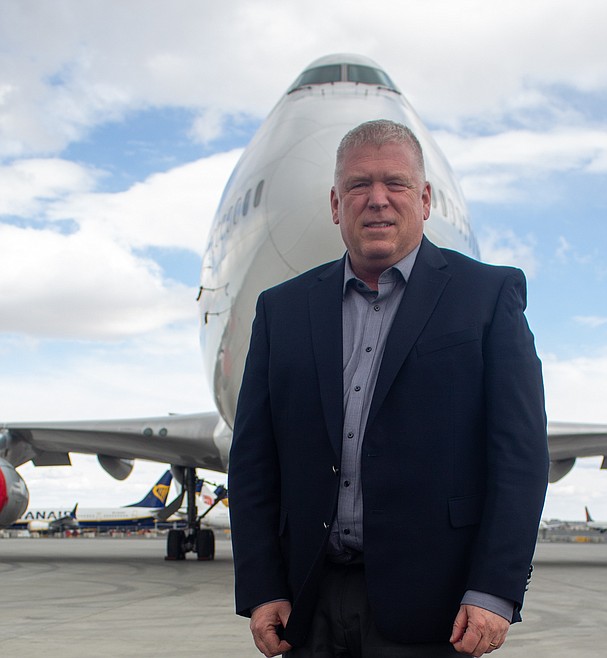
At the beginning of this year, Don Kersey took up the position as the new executive director of the Port of Moses Lake. Kersey, a native of Moses Lake and a longtime plant manager at Joyson Safety Systems (formerly Takata), sat down with the Columbia Basin Herald for a long, one-on-one interview about his life and his hopes for Moses Lake as he assumes his new job.
The interview has been edited for length and clarity.
Question: So, tell us about yourself. How long have you lived in Moses Lake? What are you hobbies? What do you like about life in Moses Lake?
Answer: I’m 56 years old, happily married to my wife Betsy, I have two beautiful daughters, Hannah and Sarah, Hannah teaches English at Chief Moses Middle School, and Sarah is a senior at Gonzaga, and she will be graduating this spring in May and going on to graduate school.
I was born and raised here. Did the normal things, jumped bikes as kids, got into as much trouble as I could, it was a great childhood. Grew up basically in Mae Valley on a farm, graduated in 1982 and went to Washington State University, and got my bachelor of science, and I went to work for Columbia Crest Winery as a lab technician, which was a blast. Worked there a couple of years, eventually got married, and then from there we moved to Portland, where I worked at Elk Cove Vineyards as assistant winemaker. I worked there two years and realized it rains way too much. Came back to the (Columbia Crest) winery, worked as a chemist, worked for the health district for a bit, but then the job at Takata came open for a lab technician and chemist.
I started there in 1992, and kind of worked my way up from chemist to lab supervisor and then in 2009 or so, I started a unique rotation where I was touted as the next plant manager. I got to work in every facet of Takata. I was in the lab, then I was in maintenance, I was crawling under presses, crawling under mills, helping repair things. Now, I was not very good at it, I’ll admit. But they wanted me to know what every part (of the company) was like, and I did that for a good year. And then to production, where I actually ran some of the presses, worked every shift, and even in accounting. In 2011, I was promoted to plant manager, and that was going good. Nothing but positive to say about my experience at Takata and Joyson. There were challenges. We were part of the world’s largest automotive recall, there was the bankruptcy (in 2017), and then the sale of the plant to the Chinese company.
But it was an amazing time, too. We had extremely low turnover in the staff. It’s like we banded together, and that was a really neat feeling, too, to get through that. The challenges were intense, but the staff was amazing. The resilience was amazing, to be put under that kind of pressure and to survive and to succeed — it turned out good.
And then the position came open at the port. Growing up in Moses Lake, the port had this mythical place. Look at it, this is the most beautiful place in the world, for me at least. I applied thinking I really didn’t have a shot. But everything worked out.
My hobbies? I love golf, I wish I was better at golf. I’m into hot sauce making. I grow my own peppers, and then in the fall, I’ll harvest them and I’ll ferment them in salt. My daughter’s old bedroom looks like a greenhouse. I got my plants started, put them in the ground around May 1. Then I harvest those peppers, chop them up, ferment them for about four to six weeks, grind them up, strain it, filter it, boil it then bottle it. The house in the fall smells like a hot sauce factory. I love giving it to friends and family, I don’t even eat that much. But I love making it, it’s a nice hobby, you get to see your progress and get to see your result. I’ve become a small farmer, I guess.
As for Moses Lake, it’s the resiliency in the community. Moses Lake has had some hard times. Up and down. It’s a good community, good family values, a lot of incredible people here. I can’t imagine living anywhere else. Moses Lake is my home. I love the people here. I want to be here. I’ve had many opportunities to work all across the United States, but this is my home. I can’t imagine not being here. This job is like a gift because now I can give back. I can create jobs to keep more people in Moses Lake. So I owe it to the town to do well in this job.
Q: How would you describe the overall economy of the Columbia Basin?
A: It’s grounded in several major areas — aviation, industry, agriculture, services, tourism. It’s really a diverse economy, way more diverse than in other towns that just rely on one thing. Moses Lake has four or five pillars that we rely upon, and it’s holding its own. And it seems like we are always looking for opportunities to grow. It’s in our nature.
The port has invested a significant amount of time and resources into making sure the economy has all it needs to be healthy and grow. We work closely with the (Grant County Public Utility District) looking at power issues, we do studies that will help us target companies that will work with our current cluster of companies in Moses Lake to help strengthen our business community. We are always reaching out. The state legislators are also very passionate about their hometown, and that’s really unique, and they are really successful at promoting our area. It’s been fantastic to work with them.
I do worry about the virus and its effect on smaller businesses ... The town is tough. It’ll make it through. I have faith.
(In the area of workforce development) the port has been extremely successful in creating pathways for youth into careers, which is a big push right now. When I was growing up, it was high school, college, boom! There was no other options. We didn’t have the industries we now have out here. So, we work closely with CB Tech and Big Bend Community College’s new Workforce Education Center. It’s really impressive. It took my breath away, to see these kids, they were learning these new careers. But what they’re teaching them more is the people skills — how do you look someone in the eye, how do you shake a hand, how to talk to an adult, and that is the most important skill you can teach someone that age. That’s worth millions in my mind.
The most recent pathway that we’ve helped create with our partners is the aviation maintenance program that will begin at the Columbia Basin Technical Skills Center this fall, and that will roll into Big Bend’s (aviation program) as well. Last year was the first year of youth apprenticeship programs for students in Grant and Adams counties, some kids placed at SGL, and we plan on working with that more and more, to get these kids involved. To give them another option.
Q: How are you settling into the job?
A: Very well. The spectrum (of things I have to deal with) is broad here. I knew it would be large, but I had no idea how large it would be. One minute, you’re working on industrial wastewater, the next minute you’re working on a lease, the next minute you’re looking at runway construction, and then the next minute you’re looking at establishing a supersonic corridor or on a conference call with NASA. I was also in the last month in front of the House Finance Committee in Olympia, being front and center testifying on House Bill 2880 (which would exempt from sales tax aviation fuel used by test aircraft). I’ve never been in front of the legislature, in my suit and tie in front of a panel of people, nervous as all can be. Things I didn’t expect, but it was a good experience. I love it. I absolutely love it.
Q: You are new to running a port. What has proven to be a challenge? What insights does your experience in industry give you?
A: If you look at the industries around here, I know from my experience what goes on in the day-to-day. What do they need? What are they looking for from the port? I’ve had a positive experience visiting all of these industries out here, too. Interesting, they are all on the same page as far as growth. I want to be there for them, because that’s what we’re about — jobs. And they employ people. So it makes me very sensitive to their needs, I’m very in tune with them.
As well as attracting new industries, we have potential industries coming in. I can relate my experience of my industry, relate to them. I know what it is to be on that side, I know the pressures they are under, and from here, how can I make their lives easier? How can I make their jobs better? Is there any way to stimulate growth to bring more jobs to Moses Lake?
As far as learning the port side, the whole public side has been a massive learning curve, but I’m getting there, quickly.
Q: What is your vision for the Port of Moses Lake? What do you hope to accomplish?
A: It’s like you’ve been given this beautiful Lamborghini as a gift, I’m learning to drive it, and now I’m going to put my foot on the gas. My vision is to see the port grow. My vision is to promote a good working environment for port employees, collaboration with projects, and fostering new ideas. I feel like I’m a servant leader. I’m not a dictator by any means, but these folks are very talented. I want to give them tools to prosper even more. It’s a very, very competent staff. I’m very lucky to be a part of it. To provide them the tools to be successful, because if they’re successful, I’m successful.
I want to see the port grow this whole west side out here. We’re going to build a road in probably early May, and once that goes in, we can really attract industry. The east side is basically full, so that’s what I want to see grow.
I also want to keep the team mentality with the other businesses located at the port and work with them to increase the visibility and success of the port. Again, if they’re successful, I’m successful.
I need to talk about the commissioners, too. We have a unique mix, a great mix. There’s David “Kent” Jones on the real estate side. I’ve learned a ton from him. There’s Darrin Jackson on the aviation side. He brings a whole new skill set. And there’s Stroud Kunkle on the financial side. You couldn’t ask for three better commissioners to learn from. I’m lucky with that.
Aerotec is looking at putting in a new hangar. This could be, will be, a world-class test facility. We have 300 days of sunshine and this uncomplicated airspace, this is just poised for success as a test facility.
Q: What are you doing to connect with the community?
A: Just talking to each industry, going into the plants, talking to them. I’m going to be joining the Rotary pretty quick, and I’m trying to get out to promote the port, saying good things about it. We’re going to continue to support the workforce development plan, and that will bring more opportunities to employment. It’s just getting out talking to each company.