
Cigar box blues

SOAP LAKE — “Nothing’s better than the sound of an acoustic guitar with your fingers sliding across the strings.”
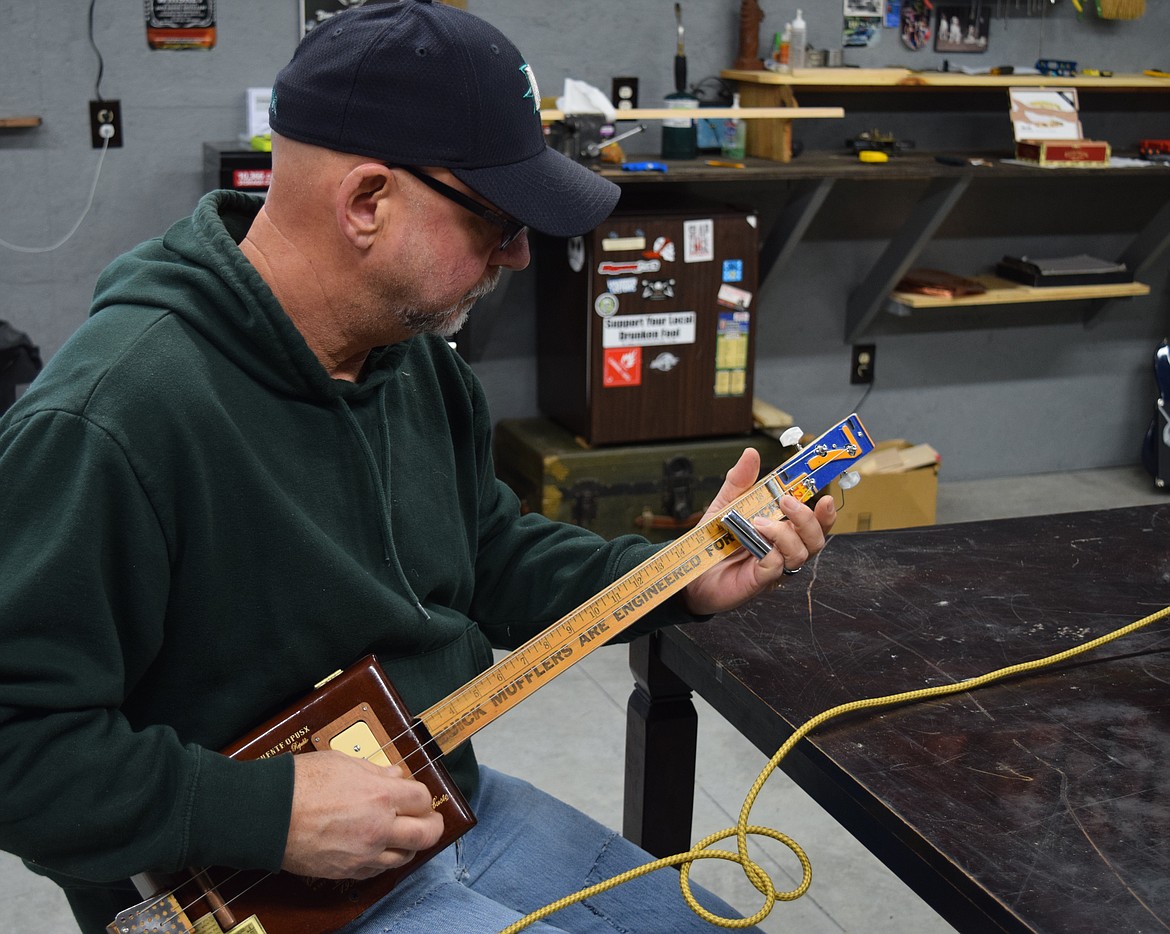
So says Steve Pfeifer as he slowly plays a little muddy Delta blues on the simple, three-stringed guitar in his hands. His right hand picks while his left hand glides over the neck, a metal slide gliding across the fretboard.
But the one Pfeifer is playing is not an acoustic instrument, and it’s plugged into a small amplifier sitting nearby. The little guitar growls and howls as he plays, sounding a little like a swamp bottom on a muggy summer afternoon in Mississippi sometime before the middle of the last century.
Only Pfeifer just built both the guitar and the amplifier. He makes the guitars from wooden cigar boxes and uses old yardsticks as the fretboards and decorates the headstock with a cutting from an old license plate.
And he builds the amplifiers from just about anything he has at hand — old radios, clocks, wooden boxes, anything.
Along with painting, it’s what he does now that he’s retired from 35 years as a lineman for Grant County Public Utility District.
“I saw one, probably on the internet, and I decided I wanted one,” he said. “Instead of buying it, I decided to build it.”
He makes anywhere from 30 to 40 of these little guitars every year, “depending on how distracted I am,” and sells them for somewhere between $60 and $100 each.
The cigar box Pfeifer uses acts as a resonator – something to amplify the sound. He can build acoustic instruments, but mostly he makes electric ones, with simple guitar pickups right below the strings.
“They don’t have a formal name,” he said of these three-stringed guitars. “If you go way back to the South, they were originally called a Diddley Bow. The slaves created them with just about anything they could find.”
“A piece of wood and a nail, a piece of barbed wire, anything that could make music,” he said.
Although he worked for the PUD, the 62-year-old Pfeifer said he has always had an artistic disposition. He studied art at Eastern Washington University in the mid-1970s for two years after graduating from Ephrata High School. Then “life, family, and everything else” got in the way, and he had to set his interests and hobbies aside for a while.
“It was a good job, a good place to work, but it’s hard work, and dangerous. I went to the hospital a few times, but I survived with all my fingers and toes intact,” he said.
Pfeifer explained that while he only fell off power poles a couple of times when he was young, the greatest danger was flash burns from high voltage electricity.
“It’s something I chose to do. Why, I don’t know,” he said.
Pfeifer said his artistic interests reasserted themselves after he retired three years ago and when his daughter Sarah was diagnosed with cancer.
“She inspired me to keep going, she really pushed me to do it,” he said. “We lost her in 2018, so I’m doing all I can to keep her memory alive.”
Pfeifer said it takes him about seven hours to make a guitar or an amplifier. He starts measuring and cutting wood, and it takes a “lot of figuring” to make sure everything comes out right.
“You just have to use good wood to start with, good solid wood,” he said.
Pfeifer prefers maple, but he usually uses pine since it’s cheaper and he wants to keep his Diddley Bows as affordable as possible. Just this month, he completed construction on a workshop out behind his home on a ridge east of Soap Lake, where he builds and he paints and where “everything is for sale.”
Including all the little guitars hanging on the wall.
“I liked ’em, so I started making them,” he said as he strummed a bluesy dirge. “As long as people keep buying them, I’ll keep making them.”
Charles H. Featherstone can be reached at [email protected].