
Sleep Center offers care close to home
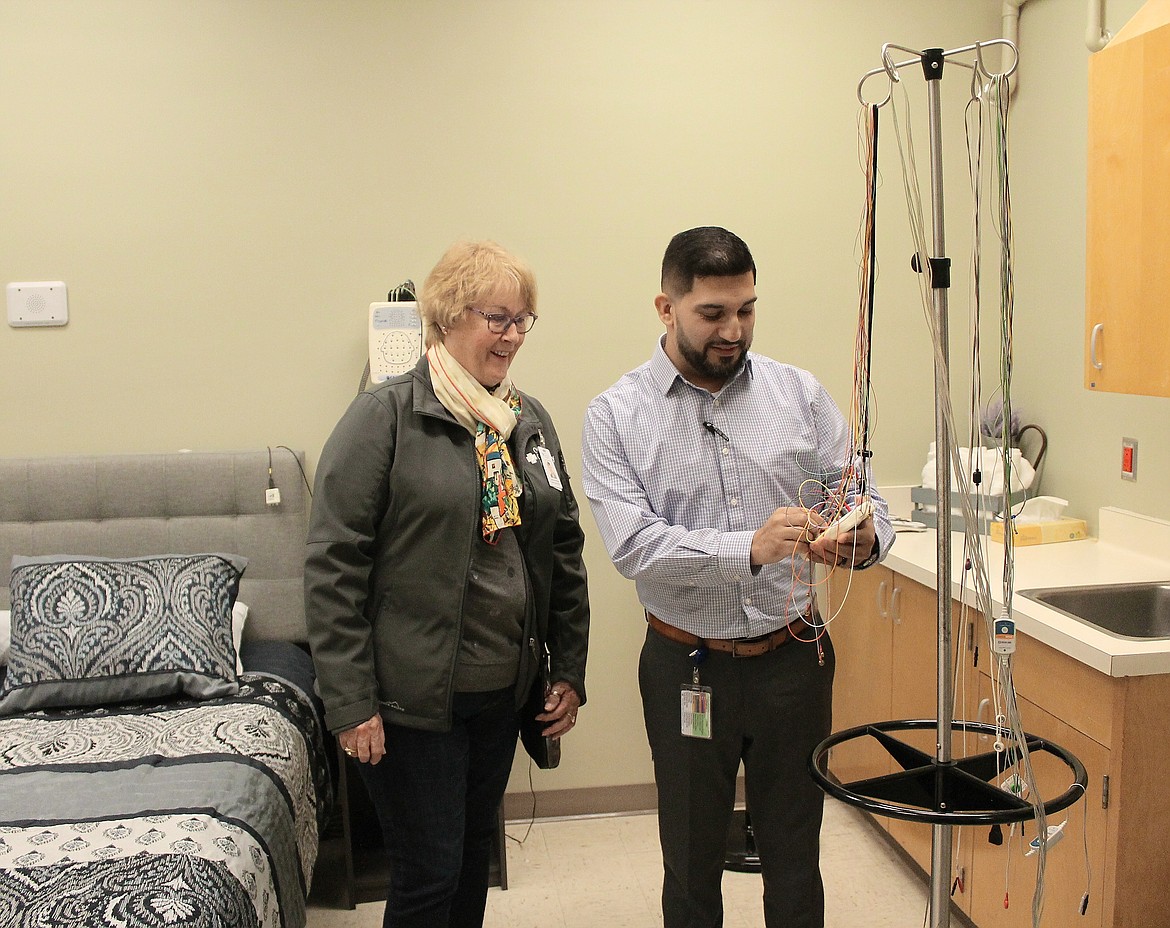
Jesse Torres (left), Othello Community Hospital Sleep Center director, shows Shirley McCullough, hospital board chairman, how the sleep test is hooked up to the patient.
Rachal Pinkerton/The Sun Tribune
OTHELLO — Those in rural communities know the struggle of getting good healthcare without having to travel a distance to get the care they need.
In 2018, Larry McCourtie, then board chair for the Othello Community Hospital, had a sleep test performed in the Tri-Cities. When he woke up at 5 a.m., it was snowing. When he got back to Othello, he told the hospital that they needed to open a sleep center. Approximately three months later, the Othello Community Hospital Sleep Center was a reality.
The Othello Community Hospital Sleep Center is a two-bed facility, located on the quiet, administrative end of the hospital. The sleep center is accredited, with the ability to do a full analytic study. They partner with Dr. Cheta Nand of the Tri-Cities. Nand is triple-board-certified.
The sleep center is designed to feel homey, according to Jesse Torres, the sleep lab director. Each room is set up with a Sleep Number-brand bed, as well as audio and video. Techs are also able to have patients put on a CPAP machine.
“It’s not your normal hospital bed,” Torres said.
Some patients have reported sleeping better during the sleep test than they have for years.
“It’s about comfort,” Torres said. “Each patient has a private bathroom.”
In one of the rooms, a large recliner is provided for caregivers to spend the night with the patients. Some patients decide to sleep in the chair themselves.
The sleep center is able to take patients 6 years old and up. Torres said that they have seen an increase in pediatric patients.
It is currently estimated that between 22 and 23 million Americans struggle with sleep apnea. Torres said that he was diagnosed with sleep apnea 18 years ago.
“I am really passionate about it,” he said. “It is preventative medicine.”
“I am amazed how many people are affected by it,” said Shirley McCullough, hospital board chair. “It really makes a difference. People have asked, ‘Why didn’t you get it sooner?’ I am really happy we pushed for it.”
Connie Agenbroad, CEO of the Othello Community Hospital, said that the sleep center is all about the patients and keeping them close to home. As a center of excellence, the sleep center is able to take both Medicare and Medicaid patients. This allows those with a limited income to get the help they need. They also are able to do home sleep tests.
“It is testing for patients that don’t want to come in or are required by their insurance,” Torres said.
Members of the trucking industry take advantage of this form of test. One trucker did the test while sleeping in the back of his truck. Torres said that patients are able to get a consultation, test, diagnosis and start on therapy in the space of a week.
Patients come back to the sleep center for follow-up tests at six weeks and again at three months after diagnosis. The sleep center also works with suppliers to get patients the equipment they need to get a good night’s sleep.
Rachal Pinkerton may be reached via email at [email protected].