


Applying solar power to cooling: Engineers foresee wide use for their technology
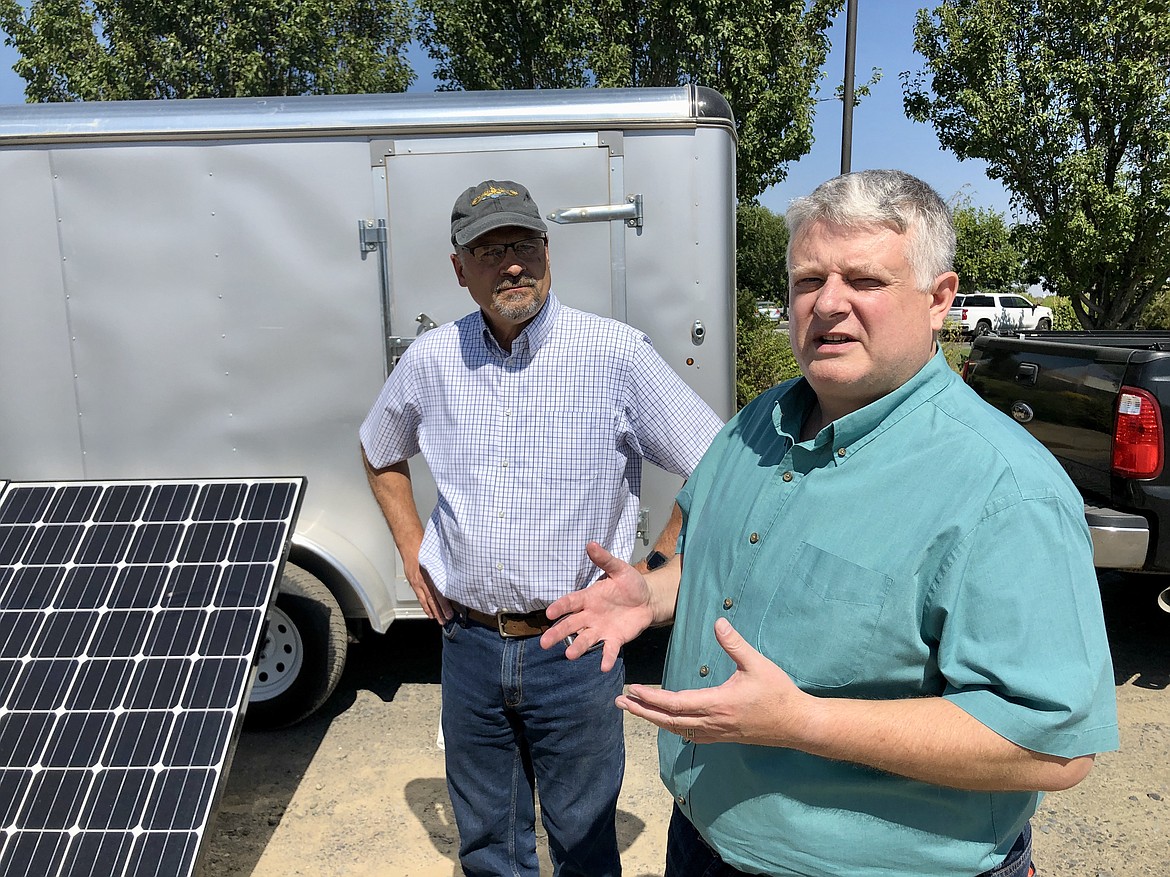
Charles H. Featherstone/Columbia Basin Herald SolarX Works Chief Executive Officer Blake Barthelmess, right, stands with company Chief Technology Officer Scott Brown in front of the cargo trailer the company cools with its prototype, solar-powered refrigerating unit.
MOSES LAKE — It is probably fair to say that Blake Barthelmess and Scott Brown would like to conquer the world.
“The current issues that we’re trying to solve right now, if you look at produce production worldwide, a lot of it spoils in the field before it makes it to the table,” Brown said.
In some parts of the world, half of all fresh produce spoils sometime after it is picked but before it gets to market, Brown said. Improving yields does little to help, since it increases the amount of produce that spoils.
“There’s been a lot of focus internationally on improving yields. You go from two tomatoes to four tomatoes. That’s fantastic,” Barthelmess said. “But you can still only bring one tomato to market. You haven’t solved a problem, you’ve created a bigger one.”
“We want to get into the field where there is no power transmission and cool the produce before it ships,” Brown added.
So Brown and Barthelmess, both former engineers at REC Silicon, started a company — SolarX Works — five years ago to look at ways to create a cooling system that is completely solar powered.
It’s taken a lot of work, a lot of tinkering and refining, but Brown and Barthelmess say SolarX Works is now on the fourth version of its sun-powered cooling prototype, and they are ready to put their system to more rigorous field tests as well as find investors to get them to the production stage.
If all goes well, they hope to see their cooling system — which can cool any sufficiently insulated space — used worldwide to help farmers preserve more of their harvest and even find markets they never dreamed of for fruits and vegetables.
First, however, they had to answer the question — can you generate enough electricity from solar power to run an air conditioner?
“Yep, we can,” Barthelmess said, describing the company’s early effort at cooling a 20-foot-long metal cargo container with power from a couple of dozen solar panels. “And it was extremely cold air.”
But Barthelmess said after some study, SolarX Works learned there wasn’t much of a market for solar-cooled cargo containers. So instead, the company focused on making its cooling technology more energy efficient, licensing some NASA technology along the way to get them going.
Typical air conditioning and cooling works by using a gas to absorb heat by compressing that gas until it’s a liquid and then allowing it to expand back into a gas. A liquid that evaporates — becomes a gas — gets cooler as it does. A process repeated over and over and over.
It takes a lot of electricity to run compressors and pumps and fans in typical cooling systems, something Barthelmess and Brown have overcome in several different and very creative ways.
“The big thing about most cooling is that it’s on or it’s off,” Brown said. “If you think of your AC at home or refrigerator, they turn on until it hits a cold point and then shuts off. Our unit never does that.”
Instead, Brown said their custom built cooler manages its power use constantly, and a variable expansion valve — the valve that allows the compressed liquid to turn back into a gas — can adjust itself depending one how much power is being generated by the sun.
“We can make it as cold as possible depending on the light that we’re getting,” Brown said. “It’s a novel approach; no one else is doing it.”
It’s one of several patents SolarX Works holds, both Brown and Barthelmess said.
It has allowed them to get down from a couple of dozen solar panels to six, which on a Thursday afternoon sat under the bright, hot Columbia Basin sun and provided the power to cool the inside of a small cargo trailer to around 38 degrees.
In addition, Brown said their air conditioning unit has a 60-pound lithium-ion battery that can power the system at 50 percent for up to eight hours. Their evaporator can also be detached and used up to 60 feet away from the condenser unit, a feature that allows the system to cool any space.
“We’re kind of space agnostic so long as it’s well insulated,” Brown said.
While they see uses in the U.S. to help get highly perishable crops like strawberries and cherries to market, Brown and Barthelmess are really excited about the uses their system might have internationally, helping farmers and greengrocers in places with little or no electricity develop markets for their goods.
“When we attended an event in Washington, D.C., and we had a conversation with some folks who supported the global cold chain in Nigeria, India and other parts of sub-Saharan Africa, it was astounding,” Barthelmess said.
The company has even been approached by Egypt’s Agriculture Ministry to possibly use the company’s cooling system to help create farmers markets up and down the country, Barthelmess said.
And even as they are looking for investors and organizations to help test their current prototype, Barthelmess and Brown are looking into other uses for their solar-powered technology, such as more efficient irrigation water pumps, powering forward bases for fire crews battling brush fires, and the creation of disinfectants like hydrogen peroxide and ozone in disaster areas that have no power.
“We have a long list of things we want to go after, and we’re starting here to get the funding going,” Barthelmess said. “This is the low-hanging fruit right now.”
Barthelmess described SolarX Works as “an applied solar technology company,” and hopes to be the first of what could be a “solar cluster” of companies doing both research and development as well as production of solar power technology.
“What we mean by the term is that we leverage solar as an energy source for niche applications,” Barthelmess said. “We’re focused on real-world challenges that can be solved with solar or other renewable energy sources.”
“Applied solar is our game,” he added.