
Hay growers hoping for good weather in 2014
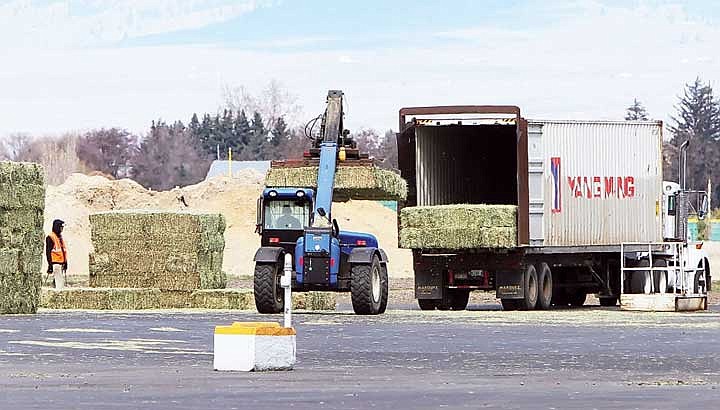
Hay is loaded into a shipping container at Anderson Hay and Grain in Ellensburg on Friday.
After rain hammered 2013's hay crop, the region's growers are hoping for better weather in 2014.
Kittitas County's Timothy hay production is estimated to be valued at about $40 million annually to growers, with up to 90 percent of the product typically going to the Japanese market.
Rain damage can cut the value that a grower and processor receives by half or more. Rain can cause soft, green hay to turn brittle with a brownish-yellow color. Baled, moist hay, also can include dark splotches of mold.
Other factors can be difficult in the hay market - the currency exchange rate, charges for ocean-going freight, competition from other growing areas, what overseas buyers are willing to pay and economic problems overseas - but growers say they can put up with those concerns. They definitely don't want to see last year repeated, with some saying it was the worst haying weather in more than 30 years.
Dependent
Last year, a large number of fields with cut Timothy hay and alfalfa in Kittitas County and throughout the Columbia Basin were hammered with rain and, at times, thunderstorms with high winds.
"It's a crop that depends 100 percent on weather," said Mark Anderson, president of Anderson Hay and Grain Co. Inc., based in Ellensburg, and doing business in Kittitas County and the basin.
"Everything relates to weather. It's by far the No. 1 factor."
Brian Cortese, Denmark-area Timothy grower in the Kittitas Valley, said the overwhelming need for growers right now is compatible weather.
"After two years of bad weather, and last year the worst, a good season would really help out all the growers," said Cortese, president of the Organization of Kittitas County Timothy Hay Growers and Suppliers.
Loren Lentz, president of the Washington State Hay Growers Association, agreed. He grows hay in Stevens County.
"Export-quality alfalfa and Timothy can have a huge economic impact on the Columbia Basin and growers in northeast Washington," Lentz said. "No one has a crystal ball, no one knows what the weather will exactly be, but it's got to be better than last year, it's just got to be."
Eastern Washington
Hay sales in the state reached nearly $679 million in 2012, the fifth highest valued crop in the state.
Benton, Franklin, Adams and Grant counties account for nearly 70 percent of the state's alfalfa production and more than 53 percent of all types of hay produced in the state, according to state estimates. One estimate is that about 15 percent of the alfalfa hay produced in all of Eastern Washington goes to the export market.
Growers in Grant County alone are estimated to produce more than 30 percent of all the hay in Washington state, with a value ranging from $180 million to $250 million annually.
Damage
Hay farmers in the Kittitas Valley estimate that about 75 percent, and in some cases up to 90 percent, of farmers' first cutting of Timothy hay last year had some level of rain damage. It ranged from light, nearly unnoticeable damage to so severe that it took it out of the quality-sensitive export market.
The second cutting got it worse: estimates are that a solid 90 percent of the crop was hurt in periodic rainfall that didn't allow enough time in between showers to dry out.
By some estimates, up to 70 percent of the first and second cutting of Timothy hay in the basin had some level of rain damage.
One basin alfalfa grower southeast of Moses Lake said up to a half of his first cutting of alfalfa was hit hard by rain, most of the second didn't get rain damage, all of the third was hurt to some degree by rain and high humidity, and the fourth cutting was seriously soaked.
It took sometimes more than 10 days of nearly continuous fluffing of windrows of cut hay with machinery to get them to dry enough to bale.
Gamble on weather
Longtime Timothy hay grower Brent DeKoning, who farms a family operation in Badger Pocket southeast of Ellensburg, said he's optimistic this year will be a typical weather pattern. That would be a moist and somewhat mild growing season followed by warmer, summer days, no rain, and brisk winds in June and July with cooler nights.
There's no guarantee it will play out that way, he said.
"You do, at times, feel like you're taking a big gamble on the weather; in some ways we all are," DeKoning said about farmers, and hay growers in particular. "In the end, you never know what you'll get at harvest time. You just keeping doing the best you can."
Become a Subscriber!
You have read all of your free articles this month. Select a plan below to start your subscription today.
Already a subscriber? Login

