
A harvest of respect
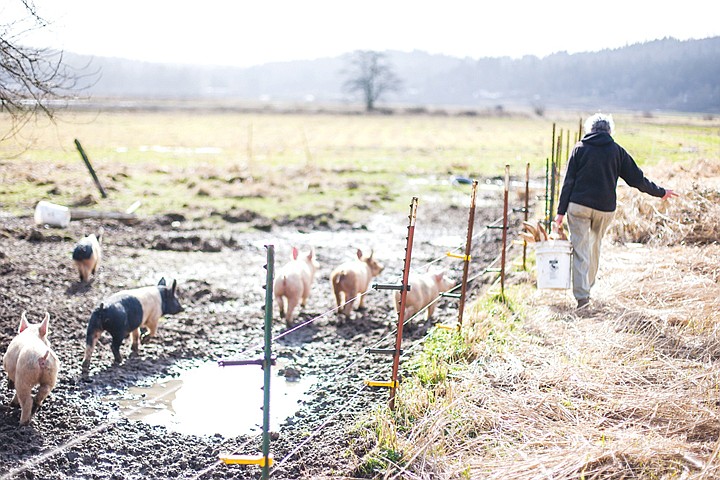
Farmer Michaele Blake attracts a following when she lugs her slop bucket along the fence.
Inspiration struck Audra Mulkern in the spring of 2013 when reached for her iPhone to capture a shot of her friend, farmer Sarah Cassidy, holding purple broccoli on Oxbow Farm. As she later studied the image, Mulkern realized that she really had a project on her hands: she was urged to document the lives of women "tasked with family, farm, and often an outside job," whose stories often go untold.
Mulkern, who lives in Seattle, has her own growing garden and is part of a thriving CSA (Community Supported Agriculture), but does not come from a farming background herself. It was in moving to Duvall, Washington 18 years ago that the girl who grew up in large cities first began frequenting markets and speaking with farmers about the crops from their fields. The self proclaimed "foodie" grew more and more in healthy eating for her and her family, and before long, she wanted to advocate for the farm-to-table movement.
It was during the summer of 2011 when Mulkern decided to take a year off from her garden to document an entire season of local farmers' markets in Carnation and Duvall. Her vibrant photographs fueled the passages and poems that would later become her self-published: "Rooted in the Valley: The Art and the Color of the Snoqualmie Valley Farmers Market." Mulkern passed on any proceeds of her work to Sno-Valley Tilth, a community of her local farmers who inspire her daily as proponents of the land.
Mulkern says she learned her way around a farm through her work as a Marketing/Event Coordinator. But unlike her day job, her work with The Female Farmer Project is not something she does for profit. Rather, Mulkern says, "if any proceeds arise, they'll go to the community. My intent is to give these farmers the attention they deserve and raise their profile."
The Project Begins
Considering how many images she was generating on her iPhone, Mulkern decided it was time to upgrade to an actual camera back in May. Though her pictures are as breathtaking as any long-time photographer's, Mulkern says she had to sit down and learn how to use the camera just like anyone else.
In the relatively short time since her project's begun, Mulkern's already set foot on 16 farms. Though she thought her main focus would be the Snoqualmie, WA region, Mulkern's since featured a North Carolina farm in her profile and knows her work won't end there. Calling this her "passion project," Mulkern is not interested in merely documenting enough stories to fit in a book; the way she sees it, since there are countless stories to be told, her Project won't necessarily have an expiration date.
Having generated attention from The Seattle Art Museum, Culture-ist Magazine, and 425 Magazine - to name several - is also asked to speak at local events about the rise of women in agriculture. The thrust of her message is respect and awareness for women as farmers.
The Female Farmer
Mulkern does not classify her Project as outright "feminist," yet says it came about partly after she noticed a void in proper representation of their actual work.
"With 14% of all farms run by women in our country, and 20% of them run by women in Washington State, it's important to realize women not only as "the farmer's wife" or "the farmer's daughter," but as the farmer," Mulkern says.
So much previous documentation of women on farms is "disappointing," Mulkern adds. A lot of the pictures are "costumey or their heads are cut out of the photograph. I wanted to capture them as I saw them... working on their passion, with the joy shining through."
When Mulkern starts taking pictures of women in the midst of farm chores, she isn't after a "staged" image. Given the rate at which farmers work, she might ask them to slow down once in awhile, but her shots are candid, "capturing them for what they're doing and for who they really are," she says.
The modern face of female farmers might surprise some. Mulkern is seeing a lot of young women serving as interns on farms, hoping to acquire their own land for the future. Another trend she sees is older women leaving their careers behind for the quieter, steadfast life that farming provides. One benefit these career women have is the fact that "they're coming in with savvy network/marketing skills and know how to use social networking" to their advantage.
Mulkern says that the shift of women in agriculture is not a subtle one. Mulkern says that the shift of women in agriculture is not a subtle one. Today 44% of FFA membership is female, and as much as 50% are now serving in leadership positions. Though these women come from diverse backgrounds, THE 2012 USDA Ag Census tell us that in Washington State 20% of all farms are owned and operated by women, 76% of those farms are considered "small" (under 50 acres), and the average age of female farmers today is 58. Fifty-four percent of female farmers have primary employment outside of the farm.
"When you look at farming as a global movement, you'll note that there's quite a gender gap. While 80% of food output is tied to women, only 1% of the land is owned by them. They have less access to resources, Yet they are the ones sharing their knowledge with fellow farmers. It helps for us to learn how women can gain more access to these rights and be aware of the poverty issue."
While American women are not suffering too badly, Mulkern has hope that projects like hers will generate more awareness and support-at the local, national, and even international levels.
Mulkern has the chance to set foot on international soil when she and her family take a long-awaited three-week trip to Europe this coming summer. Though they've been saving their nickels and dimes under the guise of her husband's 50th birthday celebration, Mulkern says that she's already aligned several sessions with farmers in the Netherlands and is hoping for bookings in France and the UK. She can hardly wait to bring her children along.
"My daughter is 14 years old now, and she's been asking me a lot more about the Project and what it is I'm documenting. It's great for her to come along and experience this with me. Both of my kids volunteer on farms during the summers, so it will be (refreshing) to have them there."
Lessons Learned
Though she first started conversing with farmers years ago, capturing their lives through pictures and words has given Mulkern closer insight into the challenging lives they lead.
One thing that's taken her back is the sheer "irony over how the people who produce our food are so busy that they often have no time to eat. During the full blown harvest, a lot of them don't stop working until 10 at night," she says.
Mulkern is awed by the toil involved on every farm she visits, and Tieton Farm and Creamery is no exception. After a quest for a specific cheese-creamy and white like a chevre, but with a milder flavor - Mulkern learned of Tieton and drove to the quaint 21 acres located just outside of Yakima, Washington and met the intensely focused and friendly farmer Ruth and cheesemaker Lori.
Realizing that their responsibilities were overflowing, Mulkern did her best not to take too much of their time; their frequent duties included not only farm chores, but making cheese, keeping the books, driving to Western Washington to make deliveries at stores, restaurants, and farmer's markets. Many of the women's recreational outlets had since disappeared, they admitted freely.
Having enjoyed her time with the women immensely - and savored some of their artisan cheese - Mulkern was later "heartbroken" when she read that their farm suffered a fire on February 24th that caused extensive damage to the structure and their chickens. With nighttime temperatures below freezing at times, the two were left scrambling to rebuild a shelter for their feed. Since farm life doesn't slow-even for emergencies-their responsibilities included birthing season and milking for their cheese.
What Mulkern was inspired to see was the support that rallied around them. Friends and neighbors have shown kindness through monetary gifts, hay delivery, replacement chicks, and the giving of their personal time. If interested in supporting this local farm, please visit: tietonfarmandcreamery.com.
It's for trying times such as these-not only the beautiful moments - that Mulkern is devoted to The Female Farmer Project. She recently raised the question on her Facebook page: "What is one thing people can do to support you?" The answers that flooded in from farmers were helpful. Among them, she heard things such as "buy local," and "spread the word on why buying from local farmers has helped your family" and "offer a hand with a social networking page that many farmers don't have time to keep up."
What's eye-opening to learn is that you don't need to have your hands in the dirt yourself to help support your local farmers and add to their voice. You can support your local farmer's market, learn more about sustainable living, or even document their work as Mulkern has begun to do.
"They (female farmers) don't live a life of short-cuts or impatience," Mulkern says, reflecting on the hard-working women she's profiled thus far. "They love the work as it unfolds. Their inspiration is not financial; the reward is in the farming."
Become a Subscriber!
You have read all of your free articles this month. Select a plan below to start your subscription today.
Already a subscriber? Login

